
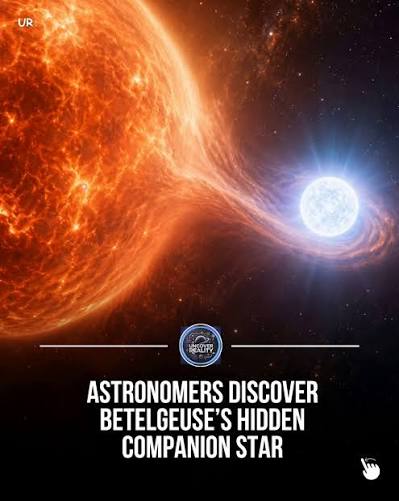
The first clear image of the elusive star could help scientists understand the strange behaviour and eventual fate of one of the sky’s most famous red supergiants.
For generations, astronomers have suspected that Betelgeuse was hiding a companion star. Now, after nearly a century of searching, they have obtained the clearest direct image yet of the elusive object.
Using the European Southern Observatory’s Very Large Telescope (VLT) in Chile, a team led by French astronomer Miguel Montargès captured what is likely Betelgeuse B, a faint companion orbiting the enormous red supergiant. The image, taken with the VLT’s SPHERE instrument in December 2024, represents the strongest evidence so far that Betelgeuse is part of a binary system.
ESO described the result as the conclusion of a “century-long quest.”
A Star That Has Kept Astronomers Guessing
Betelgeuse is one of the most recognizable stars in the night sky. Located in the constellation Orion, it forms one of the hunter’s shoulders and is easily visible to the naked eye because of its distinctive orange-red colour.
But behind that familiar appearance is an enormous and unstable star.
Betelgeuse is a red supergiant, a late stage in the evolution of a massive star. Its enormous size, powerful stellar winds and dramatic changes in brightness have made it one of the most extensively studied stars beyond the Sun.
The possibility that Betelgeuse had a companion has been discussed for roughly a century. Yet proving its existence has been extraordinarily difficult.
The suspected companion is much fainter than Betelgeuse and lies extremely close to it in the sky. The glare from the red supergiant effectively overwhelms the companion’s light, making it difficult to distinguish the two objects.
That is why astronomers have spent decades looking for indirect evidence.
The Search Finally Paid Off
The breakthrough came from combining long-term observations of Betelgeuse with increasingly sophisticated astronomical imaging techniques.
Earlier studies had identified patterns in Betelgeuse’s brightness and motion that were consistent with the presence of an orbiting companion. In 2025, NASA reported a probable direct-imaging detection using observations from the Gemini North telescope in Hawaiʻi, strengthening the case that the companion was real.
Astronomers then had an opportunity to try an even more sensitive observation.
Researchers predicted that the companion would be at a favourable position in December 2024, when it would appear farther from Betelgeuse as viewed from Earth. The VLT’s SPHERE instrument was pointed toward the star on 6 December.
The result was striking.
After processing the observations to suppress Betelgeuse’s overwhelming glare, researchers detected a faint source in the predicted location.
The candidate was detected at 6.1-sigma significance using one analysis method and 5.1 sigma using another. Its measured separation from Betelgeuse was approximately 52.32 milliarcseconds.
For comparison, a milliarcsecond is one-thousandth of an arcsecond — an extraordinarily tiny angle from Earth’s perspective.
The observation therefore required not only a powerful telescope but also extremely precise image processing.
What Does Betelgeuse B Look Like?
The image itself does not resemble a conventional photograph of two clearly separated stars.
Instead, Betelgeuse’s enormous central disk has been removed from the processed image, revealing a much fainter point of light nearby. ESO identifies this bright source as being consistent with Betelgeuse B.
The observation is significant because astronomers are detecting light from the suspected companion rather than merely inferring its existence from Betelgeuse’s behaviour.
However, researchers are careful about what the observation proves.
The object is generally described as the candidate or likely companion because its exact physical nature is still being investigated.
A Surprisingly Young Companion?
Initial interpretations suggest that Betelgeuse B could be a relatively young, hot star with a mass of roughly 2–3 times that of the Sun.
That would make it dramatically smaller than Betelgeuse itself, which is a highly evolved massive star.
But there is an important scientific complication.
A study published in August 2026 proposed that some or potentially much of the light attributed to Betelgeuse B could actually be light from Betelgeuse reflected or scattered by material surrounding the companion.
The researchers argue that a bow shock and wake produced as the companion moves through Betelgeuse’s surrounding material could scatter the red supergiant’s light toward Earth. If that interpretation is correct, the companion could be substantially different from the hot, several-solar-mass star suggested by a straightforward interpretation of its brightness.
That means astronomers may have solved one mystery while creating another: what exactly are they seeing?
Evidence From Hubble
The case for a companion does not depend solely on the new VLT image.
Earlier observations from NASA’s Hubble Space Telescope provided another intriguing clue.
In January 2026, NASA reported evidence of a wake associated with Betelgeuse’s suspected companion. The feature appears to result from the companion moving through material expelled by the red supergiant.
According to NASA, the companion is now moving behind Betelgeuse from Earth’s perspective, temporarily making it more difficult to observe directly. Astronomers expect another particularly favourable opportunity to study it as it emerges again in 2027.
The wake is important because it provides evidence of an interaction between the two objects rather than simply showing that another faint source happens to be nearby.
Why the Companion Matters
Finding Betelgeuse B is not merely an exercise in identifying another star.
The discovery could help astronomers understand how massive stars interact with companions and how those interactions affect stellar evolution.
Betelgeuse is already unusual. It has an enormous extended atmosphere, powerful stellar winds and substantial mass loss. A companion travelling through that environment could disturb the surrounding material and potentially influence the star’s observable behaviour.
New radio and millimetre observations published in 2026 have also found evidence consistent with atmospheric perturbations associated with the companion’s orbital phase.
Studying the system could therefore provide a rare opportunity to watch a massive binary system interacting at close range.
Could the Companion Explain Betelgeuse’s Changing Brightness?
Betelgeuse became a global astronomical sensation in late 2019 and early 2020 when it underwent an unusually dramatic dimming event.
At the time, some observers speculated that the star might be preparing to explode as a supernova. Subsequent observations indicated that the dimming was most likely caused by material ejected from Betelgeuse that cooled and formed dust, temporarily blocking some of the star’s light.
The newly confirmed companion does not mean Betelgeuse is about to explode.
However, its presence could help explain some of the star’s longer-term behaviour.
A companion orbiting through Betelgeuse’s extended atmosphere and surrounding material could periodically disturb that environment. Understanding those interactions may help scientists distinguish between changes caused by Betelgeuse’s own pulsations, convection and mass loss and those influenced by its companion.
Does This Mean Betelgeuse Will Explode Soon?
No. Betelgeuse is expected to eventually end its life in a supernova, but astronomers cannot predict exactly when that will happen.
The discovery of a companion adds another factor to models of Betelgeuse’s evolution, but it does not provide a countdown to the star’s death.
In fact, NASA has emphasized that Betelgeuse’s future remains uncertain. The star could explode relatively soon on astronomical timescales or remain in its current stage for much longer than a human lifetime.
For now, the companion is more valuable as a scientific laboratory than as a warning of an impending cosmic explosion.
The Next Test Will Come in 2027
The discovery is not the end of the investigation.
Because Betelgeuse B is orbiting its enormous companion, its apparent position should change over time. Tracking that motion will allow astronomers to refine the system’s orbital parameters and determine whether the faint object follows the trajectory expected for a gravitationally bound companion.
NASA and other researchers are already planning observations for the companion’s next favourable emergence. NASA estimates that it should once again become easier to detect around November 2027.
Those observations could be crucial.
If astronomers can follow Betelgeuse B around its orbit, they will be able to determine the system’s geometry more precisely and place stronger constraints on the companion’s mass and physical properties.
Future observations across different wavelengths including optical, ultraviolet, infrared and radio could also help resolve the current disagreement over whether the detected light comes directly from the companion or from material surrounding it.
A Century-Old Mystery, Finally in Focus
Betelgeuse has been familiar to humanity for thousands of years, but its suspected companion remained hidden from direct view for generations of astronomers.
Now, advanced telescopes have finally brought that companion into view.
The new VLT image is more than a striking astronomical photograph. It represents the culmination of decades of observations, predictions and technological advances and it gives scientists a new way to study one of the most unusual massive stars in our galaxy.
Yet the discovery also demonstrates how astronomy often works.
Finding the object is only the beginning.
Astronomers must now determine what Betelgeuse B actually is, how it interacts with its enormous neighbour and what its orbit can reveal about the future evolution of the system.
After a century of searching, Betelgeuse’s companion has finally emerged from the glare. The next chapter will be figuring out exactly what it has been trying to tell us.
References
European Southern Observatory (ESO). “Astronomers find strongest evidence yet that Betelgeuse has a companion.” 28 July 2026.
Read the ESO announcement
European Southern Observatory (ESO). “VLT/SPHERE imaging of the candidate companion of Betelgeuse.” 2026.
Read the technical paper/data release
European Southern Observatory (ESO). “VLT image of Betelgeuse’s companion.” 28 July 2026.
View the official image and caption
NASA. “NASA Scientist Finds Predicted Companion Star to Betelgeuse.” 23 July 2025.
Read the NASA report
NASA Hubble. “NASA Hubble Helps Detect ‘Wake’ of Betelgeuse’s Elusive Companion Star.” 5 January 2026.
Read the NASA Hubble report
Goldberg, J. A. et al. “Disco in the Dust: Reflected light at the bow shock around Betelgeuse’s companion explains its observed luminosity.” 2026.
Read the research paper on arXiv
Matthews, L. D. et al. “New Spatially Resolved Observations of Betelgeuse from the VLA and ALMA: Evidence for Atmospheric Perturbations from a Close Companion.” 2026.
Read the research paper on arXiv
Leave a Reply