
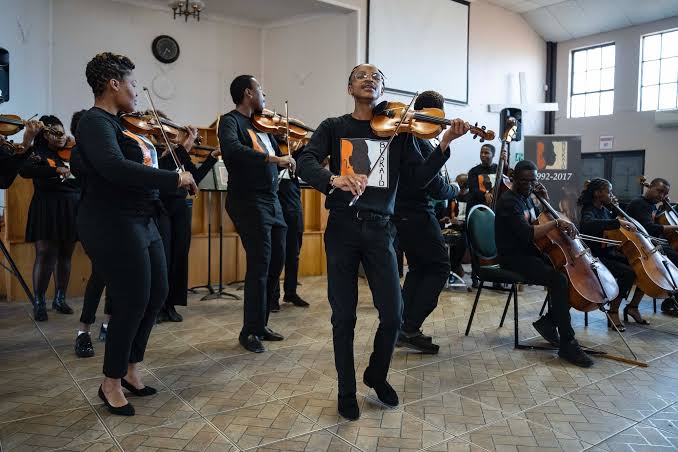
The Buskaid Soweto String Ensemble brings together European classical music and South African township traditions during a UK tour.
From the streets of Soweto to concert halls in the United Kingdom, a group of young South African musicians is showing audiences that classical music can cross borders, cultures and generations.
The Buskaid Soweto String Ensemble recently completed a UK tour in collaboration with the British chamber group Ensemble Hesperi, performing Baroque and Early Classical works alongside the energetic sounds of South African township Kwela music.
The tour included performances at venues such as St Giles Cripplegate in London, Minterne House in Dorset and the Foundling Museum, giving the young musicians an opportunity to perform for new audiences while sharing an important part of South Africa’s musical identity.
The programme was deliberately designed to bring different musical traditions together rather than treating them as separate worlds.
From Soweto to the Concert Hall
The Buskaid Soweto String Ensemble grew out of Buskaid, a music education and performance programme that provides young people in Soweto with opportunities to learn and perform classical music.
Over the years, the ensemble has developed an international reputation for combining high-level classical performance with music rooted in South African culture.
Its repertoire has expanded beyond Western classical music to include South African popular and traditional styles, allowing the musicians to move comfortably between very different musical worlds.
That versatility was central to the 2026 UK tour.
The musicians performed alongside Ensemble Hesperi, an award-winning chamber group specialising in Baroque and early music. Together, the performers created a programme that connected European musical traditions with the musical heritage of South Africa.
What Is Baroque Music?
Baroque music developed in Europe roughly between the late 16th century and the mid-18th century.
The period produced some of Western classical music’s most influential composers, including Johann Sebastian Bach, George Frideric Handel and Antonio Vivaldi.
Baroque music is often associated with intricate melodies, elaborate ornamentation, strong rhythms and the use of instruments such as harpsichord and recorder alongside strings.
For the Buskaid musicians, performing this repertoire means engaging with a musical tradition that developed thousands of kilometres away from Soweto.
But the UK performances demonstrated that classical music does not have to remain confined to the cultural setting in which it originated.
Then Came Kwela
After the formal Baroque and Early Classical programme, the atmosphere changed dramatically.
The concerts ended with Kwela, a South African township music style known for its lively rhythms and distinctive pennywhistle tradition.
The Buskaid musicians performed arrangements of traditional African township Kwela music, complete with ensemble choreography and dance.
The contrast was deliberate.
A programme that began with European Baroque and Early Classical music ended with a distinctly South African sound.
Rather than seeing the two traditions as opposites, the musicians showed how they can exist alongside one another.
The programme description for the London performance described the project as building “musical bridges” across time, borders and cultures.
The Story Behind Kwela
Kwela emerged in South African townships during the 20th century and became particularly popular in the 1950s.
The music is strongly associated with the pennywhistle, an inexpensive and portable instrument that became central to township street music.
Kwela developed from earlier South African musical traditions, including Marabi, while also incorporating influences brought by migrants from elsewhere in southern Africa.
Its upbeat rhythms and improvisational character made it popular among young people in the townships.
The music also became connected with the social and political realities of apartheid-era South Africa.
That history gives Kwela a significance beyond its sound.
When young musicians from Soweto perform it today on stages in the United Kingdom, they are not simply performing an entertaining musical style. They are carrying a piece of South African cultural history with them.
A Different Kind of Cultural Exchange
The UK tour was more than a series of concerts.
Workshops formed part of the programme, giving the young musicians opportunities to develop their skills and interact with musicians and audiences in Britain.
These exchanges are particularly valuable for young performers.
International tours can expose musicians to different performance traditions, rehearsal techniques and approaches to collaboration.
At the same time, the visiting musicians become cultural ambassadors for their own communities.
For the Buskaid ensemble, that meant bringing the sound of Soweto into spaces traditionally associated with European classical music.
Classical Music With a South African Voice
The ensemble’s approach challenges the idea that classical music has to be separated from local culture.
The musicians are trained in Western classical repertoire, but they also have access to South Africa’s rich musical traditions.
That combination gives them the freedom to move between genres.
One moment they can be performing a Baroque work with the precision expected of a chamber ensemble. The next, they can switch into the rhythmic energy of township music.
The result is not necessarily a fusion in which every musical style is blended together.
Instead, the programme allows different traditions to stand alongside each other, each retaining its identity while being heard in a new context.
The Young Musicians Behind the Music
For the young members of the Buskaid ensemble, performing internationally represents an opportunity that may not otherwise have been available to them.
Buskaid’s work has long focused on providing music education and performance opportunities for young people from Soweto.
The organisation’s broader philosophy is that musical training can provide young people with skills, discipline and pathways into professional performance.
The ensemble’s international history demonstrates how far that model can take its musicians.
The 2026 UK tour adds another chapter to that story, allowing a new generation of performers to represent Soweto on international stages.
More Than a Performance
There is something particularly powerful about the image of young musicians from Soweto performing centuries-old European music in London before ending their concerts with South African township music.
It challenges the traditional direction of cultural exchange.
Instead of South African musicians simply travelling abroad to learn from European musical institutions, they are arriving with their own musical knowledge and traditions and inviting international audiences to experience them.
The result is a two-way exchange.
The musicians learn from their international collaborators, while audiences encounter South African music through performers who know its history and meaning firsthand.
A Musical Journey Across Continents
The collaboration between Buskaid and Ensemble Hesperi demonstrates how music can connect traditions that developed in very different historical and cultural circumstances.
Baroque music emerged in European courts, churches and concert settings centuries ago.
Kwela developed in the streets and townships of southern Africa.
Yet both rely on rhythm, movement, ensemble playing and communication between musicians.
The UK performances brought these worlds into the same programme.
And perhaps that is what made the tour so meaningful.
The musicians were not being asked to choose between their classical training and their South African heritage.
They were able to celebrate both.
Soweto’s Young Musicians Look Ahead
The UK tour has now ended, but the experience is likely to remain important for the musicians involved.
Returning home with new performance experience, international connections and a broader understanding of their craft, the young musicians can carry what they learned into the next stage of their development.
For Buskaid, the goal extends beyond individual performances.
The organisation continues to use music education and performance to create opportunities for young people in Soweto.
The ensemble’s journey shows what can happen when talented young musicians are given access to training, mentorship and international platforms.
From Soweto to the World
The story of the Buskaid Soweto String Ensemble is ultimately about more than classical music.
It is about opportunity, cultural identity and the ability of young people to take something rooted in their community and share it with the world.
On the UK stage, Baroque compositions and township Kwela may seem like unlikely partners.
But in the hands of the young musicians of Soweto, the distance between them becomes much smaller.
The final message of the tour may have been the simplest one: music does not need to belong to only one place.
It can travel. It can evolve. And it can carry the story of where it came from wherever it goes.
References
Good Things Guy. “From Soweto to the World: Buskaid’s Young Musicians Shine on UK Stages.” 28 August 2026.
Read the full report
Continuo Connect. “Ensemble Hesperi & Buskaid Soweto String Ensemble — Baroque Bridges.” August 2026.
View the concert details and programme
Planet Hugill. “Ensemble Hesperi joins forces with Buskaid Soweto String Ensemble.” August 2026.
Read the music coverage
Buskaid. Official organisation and information about its music education programme and Soweto String Ensemble.
Visit the Buskaid website
Ensemble Hesperi. Official information about the UK chamber ensemble and its Baroque and early-music performances.
Learn more about Ensemble Hesperi
Leave a Reply