
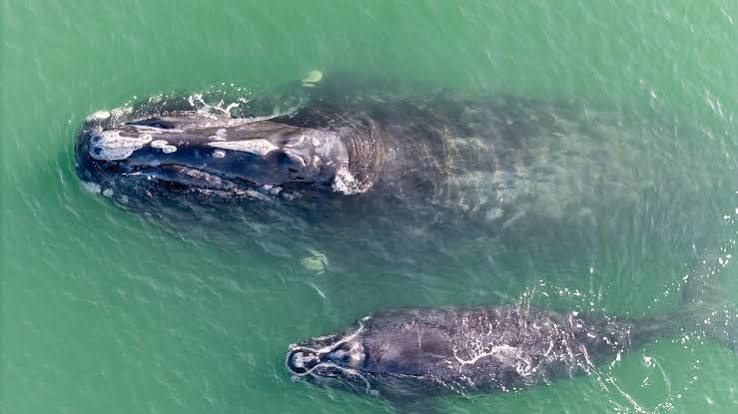
Twenty-three North Atlantic right whale calves were born during the 2025–2026 season, giving conservationists a rare reason for optimism. But scientists warn that the critically endangered species still faces serious threats.
For one of the world’s most endangered whales, the latest breeding season has brought an unusually hopeful sign.
Researchers documented 23 North Atlantic right whale calves during the 2025–2026 calving season the highest number recorded in a single season since 2009. It was also the fourth-highest number of calves ever recorded for the species.
The calves were born along the southeastern coast of the United States, where female North Atlantic right whales migrate each winter to give birth.
For a species whose total population is estimated at only around 380 individuals, every new calf matters.
But while conservationists are celebrating the baby boom, scientists caution that one successful season cannot reverse decades of population decline.
A Rare Baby Boom
The North Atlantic right whale (Eubalaena glacialis) is one of the world’s most endangered large whale species.
The 2025–2026 calving season began in November 2025 and continued through April 2026. During that period, researchers identified 23 mother-and-calf pairs in waters off the southeastern United States.
That number is particularly significant because right whale reproduction has become much slower in recent decades.
Historically, female North Atlantic right whales could produce a calf roughly every three to four years. Today, females are averaging approximately seven to 10 years between calves.
The reasons for that longer interval are still being investigated, but scientists believe factors such as poor nutrition, stress, injury and changes in the whales’ environment can affect reproduction.
Against that background, 23 births in one season stand out.
Twenty Returning Mothers
The 23 calves were born to 23 identified mothers.
Of those mothers, 20 had previously given birth, while three were first-time mothers.
Even more encouraging was the number of returning females that had produced another calf relatively quickly.
Thirteen of the returning mothers had last been documented with calves during the 2021 or 2022 seasons. That means several females reproduced after an interval shorter than the recent average of seven to 10 years.
Scientists are interested in whether this could indicate improving conditions for some females.
However, researchers caution against drawing conclusions about long-term population recovery from a single breeding season.
More years of data will be needed to determine whether the increase represents a genuine change in reproductive patterns.
A Whale on the Brink
North Atlantic right whales once numbered in the thousands.
Commercial whaling drove their numbers down dramatically before international protections were introduced. Although hunting is no longer the primary threat, the species has struggled to recover.
Today, only around 380 North Atlantic right whales remain, according to estimates cited by the New England Aquarium.
The population is particularly vulnerable because there are relatively few reproductive females.
That means the survival of every adult female and calf is crucial.
A population this small can also be heavily affected by the death of just a few animals in a single year.
The Dangers Don’t Stop at Birth
The new calves may have survived their first months, but they are entering an ocean filled with hazards.
Two of the greatest threats to North Atlantic right whales are entanglement in fishing gear and collisions with vessels.
Whales can become caught in ropes and other fishing equipment, sometimes suffering severe injuries or drowning. Vessel strikes can cause fatal injuries even when whales are not immediately detected.
The species also faces threats related to changing ocean conditions and food availability.
Right whales depend heavily on tiny crustaceans called copepods, particularly in their northern feeding grounds. When environmental conditions affect the availability of these prey, the whales may struggle to obtain enough energy to reproduce and maintain their health.
Why the Southeast Matters
Every winter, pregnant female right whales travel south to the coastal waters of South Carolina, Georgia and northeastern Florida.
The region is one of the species’ most important calving areas.
The shallow waters provide conditions where mothers can give birth and nurse their calves.
The whales’ presence also gives scientists an important opportunity to monitor individual animals.
Researchers conduct aerial and boat-based surveys to identify mothers, calves and other whales. Members of the public and volunteer sighting networks can also report sightings.
During the 2026 calving season, NOAA recorded approximately 500 sightings involving 129 individual right whales in the southeastern United States.
Those observations help scientists track the population and understand where the animals are moving.
Scientists Know Many of the Whales by Name
Because the population is so small, researchers can identify individual right whales.
Scientists use distinctive markings, scars and patterns of roughened skin called callosities to tell whales apart.
This has allowed researchers to build detailed records of individual animals, including their age, reproductive history, injuries and previous sightings.
That individual tracking is especially important for a species with so few members.
Researchers can follow a female throughout her lifetime, recording how often she gives birth and whether her calves survive.
For example, a 2026 survey documented the 44-year-old whale known as Magic with her eighth known calf, demonstrating how individual reproductive histories can provide valuable insight into the population.
A Good Year Does Not Mean the Crisis Is Over
The 23 calves are undoubtedly good news.
But scientists do not consider the North Atlantic right whale population recovered.
The species remains critically endangered, and the overall population is still far below historical levels.
There is also a significant difference between the number of calves born and the number that ultimately survive to adulthood.
Newborn whales are vulnerable during their first years of life, and surviving to reproductive age takes many years.
For the population to recover, calves must survive, females must continue producing calves and adult whales must avoid fatal injuries.
That makes reducing human-caused deaths just as important as encouraging successful reproduction.
A Race Against Time
The encouraging calving season comes at a critical moment.
Scientists have been closely monitoring the population because the number of North Atlantic right whales has declined in recent years.
A reproductive boost can help, but it cannot compensate indefinitely for deaths caused by fishing gear and vessel strikes.
Conservation measures therefore focus heavily on reducing these risks.
Speed restrictions for vessels in areas where right whales are present, changes to fishing equipment and improved monitoring are among the strategies used to reduce human-caused injuries and deaths.
The challenge is finding ways to protect the whales while allowing coastal communities, shipping industries and fisheries to continue operating.
What the 23 Calves Could Mean
The biggest question now is whether the 2026 calving season represents the beginning of a larger trend.
Researchers will be watching closely over the coming years.
If females continue producing calves at shorter intervals and more young whales survive into adulthood, the population could begin to recover.
If births fall back to lower levels, the 2026 season may instead prove to have been a temporary bright spot.
Either way, the new calves provide scientists with valuable information.
The 23 births also demonstrate that the species still has reproductive potential despite its precarious situation.
That is an important reason for optimism.
Every Calf Counts
For most whale species, 23 births might not sound extraordinary.
For North Atlantic right whales, it is a major event.
With only around 380 individuals remaining, the addition of 23 calves represents a meaningful increase in the number of young animals entering the population.
But the whales’ future will depend on what happens next.
The calves will need to survive dangerous migrations, avoid fishing gear and vessels, find enough food and eventually reach adulthood.
Their mothers will also need to survive long enough to reproduce again.
The 2025–2026 season therefore offers something the species desperately needs: hope, but not complacency.
A Reason to Keep Watching
After years of difficult news about North Atlantic right whales, 23 new calves offer conservationists a reason to celebrate.
It was the best calving season in 17 years and one of the most productive seasons ever recorded.
But the story of the North Atlantic right whale is still one of survival against the odds.
The species remains critically endangered, and the threats that have slowed its recovery have not disappeared.
For now, scientists will continue following the mothers and calves as they leave their southeastern nursery grounds and travel north.
The hope is that these 23 young whales will grow into the next generation of adults and that, unlike so many right whales before them, they will have the chance to live long enough to reproduce.
For an animal with so little room for error, 23 new beginnings could matter enormously.
References
NOAA Fisheries. “North Atlantic Right Whale Calving Season 2026.” 1 May 2026.
Read the NOAA report
NOAA Fisheries. “By the Numbers: 2026 North Atlantic Right Whale Calving Season.” 30 April 2026.
See the full season statistics
New England Aquarium. “North Atlantic Right Whale Calving Season Produces Highest Number of Births Since 2009.” 29 April 2026.
Read the New England Aquarium report
New England Aquarium. “2025–2026 North Atlantic Right Whale Mother and Calf Pairs.” 2026.
View the identified mother-and-calf pairs
International Fund for Animal Welfare (IFAW). “2026 North Atlantic Right Whale Calving Season.” 2026.
Learn more about the 2026 calving season
Clearwater Marine Aquarium Research Institute. “Right Whale Calving Season Wraps with 23 Calves Spotted.” 1 May 2026.
Read the research institute’s report
Leave a Reply