
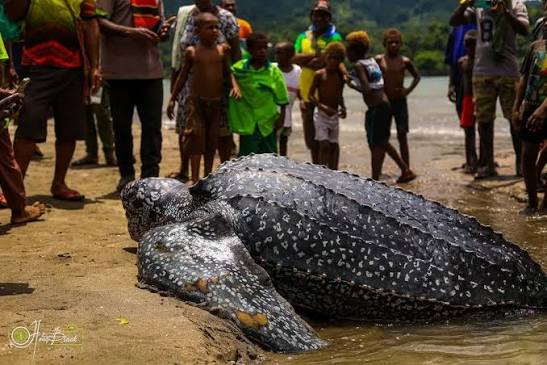
Working with coastal communities, conservationists have dramatically reduced the hunting of one of the world’s most threatened sea turtle populations.
On the Indonesian islands of Kei, one of the world’s largest and most endangered sea turtles is getting a better chance at survival.
Since 2017, a conservation partnership involving local communities, WWF-Indonesia and the U.S. National Oceanic and Atmospheric Administration (NOAA) has helped reduce the number of leatherback turtles harvested in the Kei Islands by approximately 85 percent, according to NOAA.
The achievement is significant because the Kei Islands are one of the few places in the world where groups of leatherback turtles gather close to shore to feed making them unusually vulnerable to hunting.
Rather than relying solely on outside enforcement, the conservation program has worked directly with village leaders, religious leaders, government agencies and community members to reduce the harvest.
The approach is proving that protecting endangered wildlife can sometimes depend as much on working with people as it does on protecting habitat.
A Giant Turtle in Trouble
The leatherback turtle (Dermochelys coriacea) is the largest living sea turtle. Unlike other sea turtles, it does not have a hard, bony shell. Instead, its back is covered by a flexible layer of leathery skin.
Leatherbacks are also remarkable long-distance travelers.
The Western Pacific population nests primarily in Indonesia, Papua New Guinea and the Solomon Islands before migrating thousands of kilometres across the Pacific and other oceans in search of food.
But the population has suffered a dramatic decline.
NOAA estimates that the Indo-Pacific leatherback population has declined by more than 80 percent since the 1980s. The species continues to face threats including egg harvesting, hunting, accidental capture in fishing gear, habitat degradation and other human activities.
The decline makes every adult female particularly valuable.
Leatherbacks take many years to reach reproductive maturity, meaning the loss of even a relatively small number of breeding adults can have serious consequences for a population.
Why the Kei Islands Matter
The Kei Islands are part of Indonesia’s Maluku province.
The surrounding waters are an unusual feeding area for leatherbacks. Large groups of the turtles gather relatively close to shore to feed on jellyfish and other soft-bodied organisms.
That behaviour makes the area biologically important but it also makes the turtles easier for people to find.
For decades, some communities in the islands participated in a traditional hunt of juvenile and adult leatherbacks.
The practice had deep cultural roots in some communities, meaning conservationists faced a challenge that could not simply be solved by introducing new rules.
Protecting the turtles required understanding the communities that depended on the surrounding environment.
Changing Conservation From the Ground Up
Beginning in 2017, WWF-Indonesia and NOAA worked with communities in villages where leatherback hunting traditionally occurred.
Instead of treating local residents simply as a source of the problem, conservationists sought to make them part of the solution.
The program involved working with:
- Village leaders
- Religious and cultural leaders
- Local fisheries authorities
- Community monitoring teams
- District and provincial governments
- Local residents involved in traditional hunting
Community members were involved in monitoring the number of turtles harvested, allowing conservationists to track whether hunting levels were actually changing.
This approach helped shift conservation from something imposed from outside to something communities could participate in directly.
According to NOAA, the number of leatherbacks harvested in the Kei Islands has fallen by approximately 85 percent since 2017.
The Numbers Are Even More Encouraging in Newer Reports
Recent reporting from WWF provides an even more optimistic figure.
According to WWF’s 2026 account of the project, monitoring data indicate that the number of leatherbacks harvested in the Kei Islands has decreased by approximately 95 percent since outreach efforts began.
The difference between the 85% figure reported by NOAA and the newer 95% figure reported by WWF reflects differences in the reporting period and underlying monitoring data.
Both figures point in the same direction: leatherback hunting in the Kei Islands has fallen dramatically since the conservation program began.
The reduction should not, however, be interpreted as meaning that the leatherback population itself has increased by 85 or 95 percent.
It means that substantially fewer turtles are being harvested.
That distinction matters because population recovery can take decades.
A Similar Success on Buru Island
The conservation work is not limited to the Kei Islands.
Several hundred kilometres away, on Buru Island, conservationists have focused on protecting nesting leatherbacks and their eggs.
Before the project began, approximately 60 percent of leatherback nests on Buru were being poached by villagers, according to NOAA.
Since community-led conservation efforts began in 2017, nest poaching has fallen to less than 1 percent, while the killing and consumption of nesting females has ended.
That transformation has been supported by local conservation groups, village leaders and government officials.
Conservationists have also helped establish community-based monitoring groups and supported local laws against taking leatherback eggs and nesting females.
The success on Buru demonstrates how different threats can require different community-based solutions.
On Buru, the priority is protecting nests and breeding females.
On the Kei Islands, the priority has been reducing the hunting of turtles in coastal waters.
Former Hunters Are Becoming Protectors
One of the most striking aspects of the conservation effort is the involvement of people who previously participated in hunting.
On Buru Island, some former poachers have become community wildlife monitors.
WWF reports that former hunters now patrol nesting beaches, collect data and help protect turtles and their nests.
This approach can be especially powerful because local residents already understand the landscape.
They know where turtles emerge from the water, where nests are located and how people in the community use the surrounding environment.
Instead of excluding communities from conservation, the program gives them a direct role in protecting the animals.
Why Local Leadership Matters
Indonesia is an enormous archipelago made up of thousands of islands, making wildlife protection particularly challenging.
Government regulations may exist, but enforcing them across remote coastal communities can be difficult.
Local leadership can therefore make an enormous difference.
On the Kei Islands, conservationists have worked with religious and cultural leaders because traditional practices can be deeply connected to community identity.
On Buru, conservationists have worked with village and government leaders to establish local rules protecting turtles and their eggs.
The strategy is based on a simple principle: conservation is more likely to succeed when the people living alongside wildlife are involved in deciding how that wildlife should be protected.
A Marine Protected Area Adds Another Layer of Protection
Community conservation is also being supported by government action.
The Kei Islands have an established Marine Protected Area, which provides another mechanism for protecting important marine habitat and supporting the recovery of leatherbacks.
Buru Island has also taken significant steps toward protecting its surrounding waters. WWF reported in 2026 that the Indonesian government established a marine protected area covering approximately 142,000 acres around Buru Island.
Protected areas alone cannot solve every threat facing leatherbacks, but they can provide a framework for managing important feeding and nesting habitats.
Combined with local monitoring and reduced hunting, they create a stronger conservation network.
The Threats Don’t End With Hunting
Reducing hunting is a major achievement, but leatherbacks still face serious threats.
One of the biggest is bycatch the accidental capture of turtles in fishing equipment intended for other species.
Leatherbacks also face threats from:
- Egg collection
- Habitat degradation
- Coastal development
- Marine pollution
- Climate change
- Fishing activity
- Loss of nesting habitat
NOAA identifies reducing fisheries bycatch and in-water harvest, protecting nesting beaches, improving monitoring and strengthening international cooperation as key priorities for Pacific leatherback recovery.
Because leatherbacks travel across international boundaries, protecting them requires cooperation between many countries.
A turtle that nests in Indonesia may spend much of its life thousands of kilometres away.
Why Every Adult Turtle Counts
Leatherbacks are long-lived animals that reproduce relatively slowly.
Females return to nesting beaches repeatedly during their reproductive years, laying multiple nests during a season.
But only a small proportion of hatchlings survive to adulthood.
This means that protecting adult turtles can have an important effect on the future of the population.
Reducing the hunting of breeding adults in the Kei Islands therefore represents more than simply saving individual animals.
It could help preserve the reproductive capacity of an already depleted population.
A Conservation Model Built Around People
The success in Indonesia offers a broader lesson for conservation efforts around the world.
Wildlife protection does not always work when communities are treated as outsiders to conservation.
In the Kei Islands and Buru Island, conservationists have instead worked with local residents, community leaders and government authorities.
The results are striking.
Hunting in the Kei Islands has fallen by roughly 85 percent according to NOAA, with newer WWF monitoring reporting an approximately 95 percent decline. On Buru Island, nest poaching has dropped from around 60 percent to less than 1 percent.
These numbers do not mean the leatherback has been saved.
The Western Pacific population remains in serious trouble.
But they demonstrate that human behaviour can change and that conservation can make measurable progress when local communities are given a meaningful role.
The Long Road to Recovery
The ultimate goal is not simply to stop turtles from being hunted.
It is to rebuild a population capable of surviving for generations.
That will require continued protection of nesting beaches, safer migration routes, reduced fishing-related deaths and long-term monitoring.
It will also require communities to remain involved.
In Indonesia, that work is already underway.
A species that has lost more than 80 percent of its Indo-Pacific population since the 1980s still faces an uncertain future. But the dramatic decline in hunting across the Kei Islands shows what can happen when conservation becomes a shared responsibility rather than an outside demand.
For the world’s largest sea turtle, that shift could make the difference between continued decline and a genuine chance at recovery.
References
NOAA Fisheries. “Recovering Endangered Indo-Pacific Leatherback Turtles.”
Read the NOAA conservation report
NOAA Fisheries. “Leatherback Turtle.” Species in the Spotlight priority actions and conservation information.
Read the NOAA species profile
NOAA Fisheries. “Funding will support sea turtle and Hawaiian monk seal conservation efforts in the Pacific.”
Read about the Kei Islands conservation program
World Wildlife Fund (WWF). “How One Island Is Saving the World’s Biggest Turtle.” 2026.
Read the WWF feature
Frontiers in Marine Science. “Community Engagement: An Integral Component of a Multifaceted Conservation Approach for the Transboundary Western Pacific Leatherback.” 2020.
Read the scientific research
Wahyurini, O. D. et al. “How Conservation Messages Are Constructed: A Dramatistic Pentad Study of Leatherback Turtle Conservation in Papua, Indonesia.” F1000Research, 2026.
Read the research article
Leave a Reply