
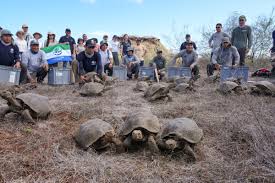
In a remarkable conservation success story, giant tortoises have returned to Ecuador’s Floreana Island in the Galápagos archipelago nearly 150 years after they disappeared from the island.
Scientists and conservationists say the return of these iconic reptiles represents more than just the recovery of a species it is a major step toward restoring an entire ecosystem.
A Species Lost to History
Giant tortoises once roamed freely across many of the Galápagos Islands. However, during the 18th and 19th centuries, sailors, whalers, and settlers hunted tortoises extensively for food. Combined with habitat destruction and the introduction of invasive species, these pressures caused several tortoise populations to decline dramatically.
On Floreana Island, the native giant tortoise population was believed to have gone extinct by the mid-1800s.
For generations, the animals existed only in historical records and museum specimens.
An Unexpected Discovery
Hope emerged when scientists studying tortoise populations on other Galápagos islands discovered that some living tortoises carried genetic ancestry linked to the extinct Floreana population.
This discovery opened the door to an ambitious conservation effort.
Researchers launched a selective breeding program designed to increase the proportion of Floreana tortoise ancestry in future generations. Over many years, conservationists carefully bred tortoises and monitored their genetic makeup.
The goal was to create a population that closely resembled the original tortoises that once lived on Floreana.
Returning to Their Native Island
After years of preparation, conservation teams began reintroducing young tortoises to Floreana Island.
The animals were released into protected areas where they could safely adapt to their environment while helping restore natural ecological processes.
Conservationists view the reintroduction as one of the most significant restoration projects ever undertaken in the Galápagos.
Why Tortoises Matter
Giant tortoises are often referred to as “ecosystem engineers.”
As they move across the landscape, they disperse seeds, create pathways through vegetation, and influence plant growth patterns. Their activities help maintain healthy ecosystems and support other species.
Without tortoises, some native plant species struggle to spread naturally across the island.
By returning these animals to Floreana, scientists hope to restore ecological functions that have been missing for more than a century.
A Global Conservation Success Story
The Galápagos Islands are famous for their unique wildlife and their role in shaping our understanding of evolution. Today, they continue to serve as a living laboratory for conservation science.
The return of giant tortoises demonstrates how modern genetics, long-term planning, and international cooperation can help reverse some of the damage caused by human activity.
Although many endangered species around the world still face significant challenges, projects like this show that recovery is possible when conservation efforts are sustained over time.
Looking Ahead
Scientists will continue monitoring the tortoises and the island’s ecosystem to assess the long-term impact of the reintroduction program.
Early signs are encouraging, and conservationists hope the population will continue to grow in the coming decades.
For many researchers, the return of giant tortoises to Floreana Island is a powerful reminder that extinction does not always have to be the final chapter in a species’ story.
Sometimes, with enough dedication, science and conservation can help write a new one.
Leave a Reply