
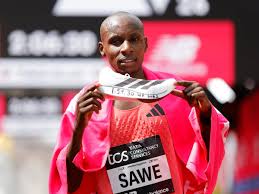
Kenyan long-distance runner Sabastian Sawe made athletics history after becoming the first person ever to officially run a marathon in under two hours during a standard race competition at the London Marathon.
Sawe stunned the sporting world by completing the 42.2 kilometre race in an extraordinary time of 1 hour, 59 minutes, and 30 seconds, officially breaking one of the greatest barriers in endurance sports. The achievement immediately sparked celebrations across the athletics community and marked a historic moment in marathon running.
For decades, sports scientists, coaches, and athletes debated whether it would ever be possible for a human being to run an official marathon in under two hours under standard race conditions. While Eliud Kipchoge famously completed the marathon distance in under two hours during the specially organized INEOS 1:59 Challenge in 2019, the performance was not officially recognized as a world record because of controlled race conditions and rotating pacemakers. Sawe’s run in London, however, met all official marathon regulations, making it the first recognized sub-two-hour marathon in history.
The race drew massive international attention as fans lined the streets of London to witness what many now describe as one of the greatest moments in sporting history. Sawe maintained a relentless pace throughout the race, averaging under 2 minutes and 51 seconds per kilometre while battling physical exhaustion and mental pressure over the entire distance.
Athletics experts praised not only Sawe’s physical conditioning but also his discipline, race strategy, and mental strength. Analysts noted that advancements in training methods, nutrition, sports science, and running shoe technology have all contributed to the evolution of marathon performance in recent years.
Following his historic victory, congratulatory messages poured in from athletes, world leaders, and sporting organizations across the globe. World Athletics described the achievement as a “transformational moment” for the sport, while fans on social media celebrated Sawe as the athlete who finally turned the impossible into reality.
In interviews after the race, Sawe credited years of hard work, sacrifice, and inspiration from fellow Kenyan runners for helping him achieve the milestone. He also acknowledged the influence of Eliud Kipchoge, whose groundbreaking sub-two-hour performance in 2019 inspired a new generation of marathon athletes to believe the barrier could eventually be broken officially.
Kenya’s long-standing dominance in long-distance running was once again highlighted by the achievement. The country has produced some of the greatest marathon runners in history and continues to play a major role in shaping the future of distance athletics.
Sports historians have already begun comparing Sawe’s accomplishment to other iconic moments in athletics, such as Roger Bannister’s first sub-four-minute mile in 1954. Many believe the achievement could redefine marathon running and inspire athletes around the world to push human endurance even further.
Beyond the sporting achievement itself, Sawe’s victory became a global symbol of perseverance, ambition, and human potential. Millions of people around the world followed the race online, celebrating not only the record-breaking time but also the message that limits can continue to be challenged and overcome.
As the athletics world reflects on this historic moment, Sabastian Sawe’s name is now permanently written into marathon history as the runner who officially broke the two-hour barrier for the very first time.
Leave a Reply