
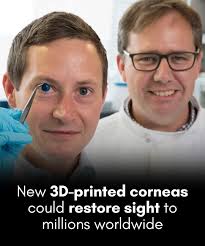
In a world-first medical milestone, surgeons have successfully implanted a 3D-printed cornea made entirely from lab-grown human cells, restoring vision to a patient who was previously legally blind a breakthrough that experts are calling a game changer for millions living with corneal blindness around the globe.
The groundbreaking surgery was performed on October 29, 2025, at the Rambam Eye Institute in Haifa, Israel, where a team of ophthalmologists led by Professor Michael Mimouni completed the world’s first 3D-bio-printed corneal transplant on a patient with severe corneal disease.
A New Frontier in Restoring Sight
Unlike traditional corneal transplants which depend on scarce donor tissue this innovative procedure uses a lab-grown, bio-printed corneal implant called PB-001, developed by biotech firm Precise Bio. The implant is made from cultured human corneal cells, printed in precisely layered structures that replicate the clarity, strength and optical properties of a natural human cornea.
In this historic surgery, doctors used cells from a single donated human cornea to produce hundreds of identical, lab-grown corneal grafts. This could dramatically reduce the global shortage of donor corneal tissue a shortage that currently leaves millions waiting for sight restoring surgery.
“This is a game changer,” said Professor Mimouni, describing the moment the lab-grown cornea successfully restored vision. “It was an unforgettable moment a glimpse into a future where no one has to live in darkness because of a shortage of donor tissue.”
Why This Matters
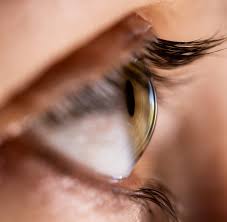
The cornea the clear, dome-shaped surface at the front of the eye plays a crucial role in focusing light and protecting internal structures. Damage from injury, infection, scarring or disease can cloud this surface and lead to partial or complete blindness. Traditionally, corneal transplants rely on tissue donated after death, but only about one cornea is available for every 70 people in need.
With PB-001, that dynamic could shift. The technology uses robotic 3D bio-fabrication to create corneal implants that are compatible with standard surgical techniques and can be cryopreserved for future use.
Dr. Anthony Atala, co-founder of Precise Bio, noted that producing “patient ready tissue on demand” could not only help people regain sight but also reshape transplant medicine worldwide.
Looking Ahead
The October 29 procedure was performed as part of an ongoing Phase 1 clinical trial at Rambam Medical Center. The trial aims to evaluate the safety and tolerability of the PB-001 implant in patients with corneal endothelial dysfunction, with early outcomes expected in 2026.
While this innovative treatment is still being studied, this first success offers renewed optimism for people with corneal blindness and points toward a future where access to sight restoring surgery could be far more equitable even in regions with limited donor tissue.
References
- Rambam Health Care Campus: Global First at Rambam: A 3D Printed Cornea Restores Sight — details of the surgery and its significance. (Rambam Health Care Campus)
- Ophthalmology Management: Precise Bio Achieves World’s First 3D-Bio-Printed Corneal Implant — overview of the PB-001 implant and clinical trial context. (PentaVision)
- Ophthalmology Times: Precise Bio completes procedure using PB-001, a 3D-bioprinted corneal implant — clinical trial design and expert quotes on impact. (Ophthalmology Times)
- BioSpace: Precise Bio Achieves World’s First 3D-Bio-Printed Corneal Implant — company and surgeon insights on the landmark procedure. (BioSpace)
- KNEWS: Blind no more: World’s first 3D-printed cornea restores woman’s sight — patient outcome and future potential. (Knews)
Leave a Reply